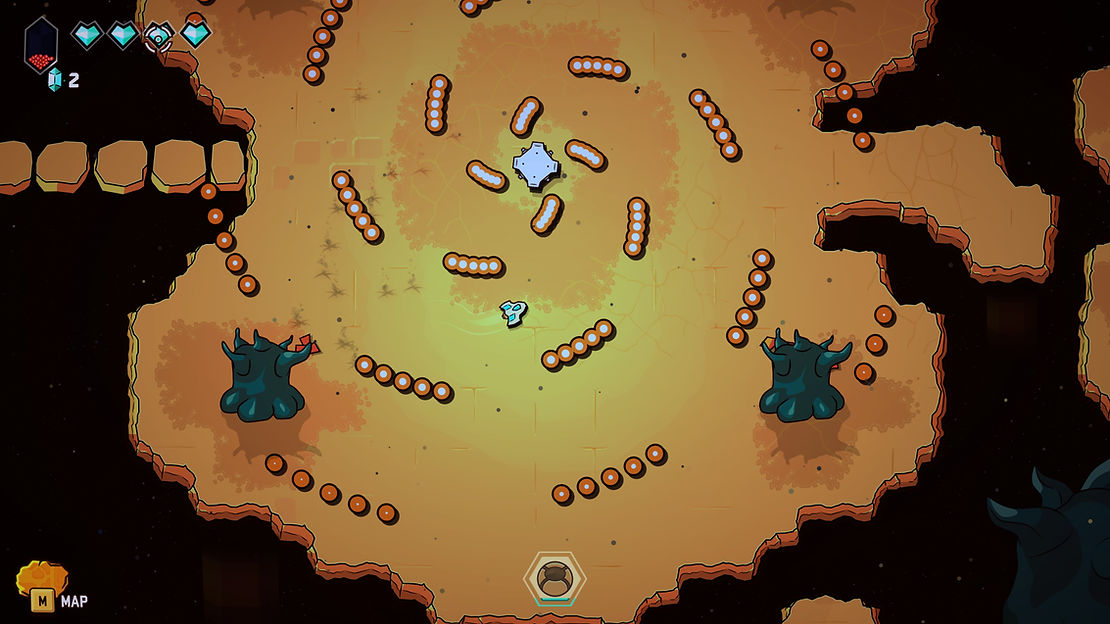
Minishoot’ Adventures is a weird sounding game that is actually just a mashup of two very normal genres. It’s both a top down bullet hell-style twinstick and a 2D Zelda style adventure game. I’m surprised that this combo isn’t more common since both genres lend themselves pretty well to the other. Bullet hell works great for the bosses and locked-room combats that the Zelda games are known for, and the upgrades and abilities you’d expect to find in a dungeon translate easily into firepower and mobility improvements on the bullet hell side. Obviously it’s best if you’re a fan of both genres, but it’s so easy to see this as just a slightly weird entry in one or the other that I think it’s worth a look even if you only like one.

Minishoot’ Adventures starts you out on a blank map with a pea shooter gun and hardly any health. You’ll quickly learn that fighting enemies rewards you with experience that can eventually be used to upgrade your core abilities. More importantly, you’ll find caves that are full of both mandatory and optional progression items. You might expect these to all be pretty same-y in a bullet hell game, but there’s actually quite a wide variety of items to find. Sometimes you’ll find a friendly NPC who gives you access to new facilities in the hub, other times you’ll find a new core ability you need to progress, and still other caves might give you heart pieces or secret items that come with unique passive bonuses. Every cave has something, and many of them have additional rewards that are only accessible if you come back later.
Exploration is also rewarded on the overworld, where you can find secret passageways and hidden switches that unlock access to new areas. There are even optional boss fights you can find either wandering around the map or trigger by shooting a mundane-looking object. It’s very rare that Minishoot’ Adventures doesn’t give you something cool for poking around the map, and even when you are left empty-handed, it usually just means you’ll have to come back later with new abilities. It reminds me a lot of the way a game like Minish Cap crammed made a relatively small map feel much larger by turning almost everything into hidden extra content.

The other highlight of the game is, as you’d hope, the combat. There are a wide variety of bosses and enemies with their own attack patterns, and many of the later bosses have numerous stages that build on each other. My favorite fights tended to be when the game sealed off a small space and started spawning loads of normal enemies. These don’t have quite the same scale as fighting a gigantic boss, of course, but it’s very satisfying to come out on top after the game has filled the screen with bullets from several dozen enemies all swarming you at once. Having said all that, while the combat is fun, it might be too easy for some players. I’m not particularly great at bullet hell games (I can beat Touhou games, but only with continues), but I only died a couple of times on normal difficulty and cleared the final boss without taking damage at all. I definitely wouldn’t recommend explorer mode unless you’re very new to this genre or want a total pushover, and it might be unsatisfying to bullet hell aficionados even on the higher difficulty.
Difficulty aside, my only other notable criticism is the lack of maps in dungeons and caves. I don’t mind this when you’re exploring an area for the first time, but it makes looking for secrets later on needlessly tedious. The overworld gives you a detailed map once you’ve explored an area enough, so I’m not sure why caves couldn’t work the same way. Especially when some cave systems have several entrances that don’t all connect underground, it can be very frustrating to have the collectible marker go off on every entrance to a cave when there’s really just one small thing you missed from one entrance. One collectible type tends to be hiding in random pots you need to shoot, which means a dungeon that’s still showing incomplete could come down to re-exploring the entire dungeon again to shoot all the pots. I’d have liked a more time-friendly solution to finding these.
Conclusion
The low difficulty and lack of dungeon maps are really only minor points against Minishoot’ Adventures, though. This is a great experience from start to finish that succeeds at both rewarding exploration and not bloating the experience with fluff. Here’s hoping this becomes a series – I think there’s still room to keep building on this idea in a larger game.
Rating: 90%
Time to beat: About 10 hours to beat the game and collect most secrets
Price: $15
For another good Zelda-like, see Death’s Door Review: A New Spin on Zelda
Feel free to leave a question or comment below!
For more reviews, see my Steam curator page: https://store.steampowered.com/curator/43219041


